
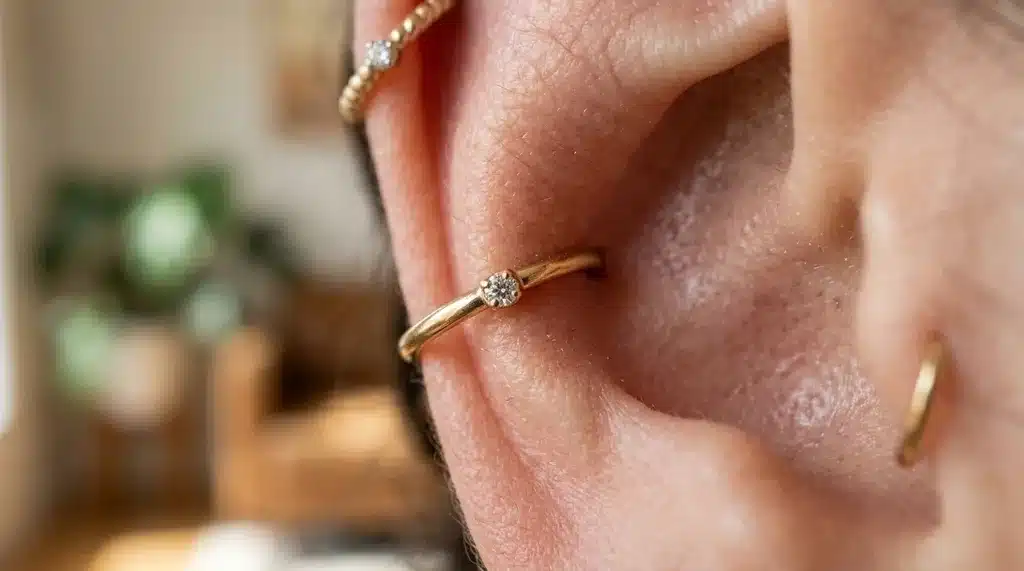

Cartilage piercings take longer to heal than lobe piercings, and people underestimate just how long which might lead to severe piercing irritation and bumps.
A cartilage piercing healing stages range from 6 months to a full year, or even longer.
During that time, your body works through distinct phases.
Cartilage piercings heal in three main stages: the inflammatory phase (0-2 weeks), the proliferative phase (2-12 weeks), and the remodeling phase (3-12 months).
Full healing takes 6 to 12 months on average, though some piercings take up to 18 months.
Why Does Cartilage Piercing Take Longer to Heal?
Cartilage has no direct blood supply.
Unlike the soft tissue of your earlobe, cartilage relies on surrounding tissue to deliver oxygen and nutrients to the wound site.
That limited circulation slows every stage of the healing process down.
This is the primary reason cartilage piercings take 6 to 12 months to heal, compared to just 6 to 8 weeks for a standard lobe piercing.
The tissue itself is also denser and less flexible.
Any movement of the jewelry disrupts the forming channel more than it would in soft tissue.
That means more sensitivity to pressure, a higher risk of hypertrophic scarring, and a longer road to a fully stable piercing.
How to Clean a New Cartilage Piercing?
Use a sterile saline wound wash, 0.9% sodium chloride, no additives.
A pre-mixed sterile saline spray rather than homemade salt water, which is often too concentrated and damages tissue.
Spray the front and back of the piercing twice a day. Let it air dry. Do not use cotton balls.
Cartilage Piercing Healing Stages
Cartilage piercings often look healed in a few weeks but remain internally weak for months. Read more about the healing timelines below.
The Inflammatory Phase: Weeks 1 and 2
This is the most visible stage. Your body treats the new piercing as a wound because it is one.
Expect redness, swelling, warmth, and some throbbing around the site.
A small amount of clear or whitish fluid is normal. This fluid dries into a crust around the jewelry, but it’s not an infection.
It is lymph fluid, part of the body’s standard wound response.
Do not rotate the jewelry or pick off the crust.
Both of these actions reopen the wound and push bacteria inside the piercing channel.
The Proliferative Phase: Weeks 2 and 12
Swelling goes down, redness fades, and the site looks more settled, but it is not healed.
This is when your body builds new tissue inside the piercing channel.
The collagen forms, the skin cells migrate into the channel to line it, and the piercing starts to look and feel more stable.
You may still notice occasional discharge, particularly after sleeping on that side. This is normal.
The Remodeling Phase: Month 3 Through 12
The channel looks healed from the outside.
The skin around the jewelry appears normal. But inside, the tissue is still strengthening and maturing.
Cartilage piercings are not fully healed until the channel feels smooth and dry, no tenderness when you move the jewelry, no discharge, and no sensitivity to pressure.
Changing jewelry too early is the reason healed piercings fail.
Wait until at least month 9 for a helix or flat piercing. Daith, rook, and conch piercings may take 12 to 18 months to heal.
Signs Your Cartilage Piercing is Infected vs Normal
Cartilage infections are more serious than lobe infections because the cartilage has limited blood supply, making it harder for the body to fight the infection on its own.
If you suspect infection, see a doctor. Do not remove the jewelry yourself.
Removing jewelry from an infected piercing can trap bacteria inside the closed channel.
Normal healing looks like:
- Clear or whitish crust that flakes off.
- Mild tenderness when bumped.
- Occasional swelling after sleeping on it.
- Itching as new skin forms.
Infection looks like:
- Yellow or green discharge with a foul smell.
- Skin that is hot to the touch beyond the immediate piercing site.
- Fever or swollen lymph nodes near the ear.
- Spreading redness past the jewelry edges.
- Piercing that is painful even when not touched.
Is Cartilage Piercing Reversible?
Yes. If you remove a cartilage piercing and leave it out, the hole will usually close, though the timeline varies.
Fresh piercings can close within hours.
Older, healed piercings may leave a small permanent mark or narrow the opening but not close fully. Cartilage piercings are harder to reverse completely than lobe piercings.
Conclusion
Cartilage piercing healing is not only complicated but also slow.
Clean twice daily with sterile saline, sleep away from the piercing, and leave the jewelry alone until the 9-month mark at minimum.
Problems traced back to cartilage piercings come from changing jewelry too early or over-handling the site.
People Also Ask
1. Can I Change my Cartilage Piercing After 2 Months?
No. At 2 months, the internal channel is still forming. Wait 6 to 9 months longer for complex placements.
2. Why is There a Hard Lump Next to My Cartilage Piercing?
A hard lump is most likely a hypertrophic scar caused by pressure or irritation. It is not a keloid in most cases.
3. Is it Normal for a Cartilage Piercing to Still Hurt After 3 Months?
Mild sensitivity at the 3-month mark is normal if the piercing is bumped or pressed. Constant unprovoked pain is not.
4. Can I Swim with a New Cartilage Piercing?
No. Swimming in pools, lakes, or the sea during the healing period. Both chlorinated water and natural water sources introduce bacteria to the open channel.